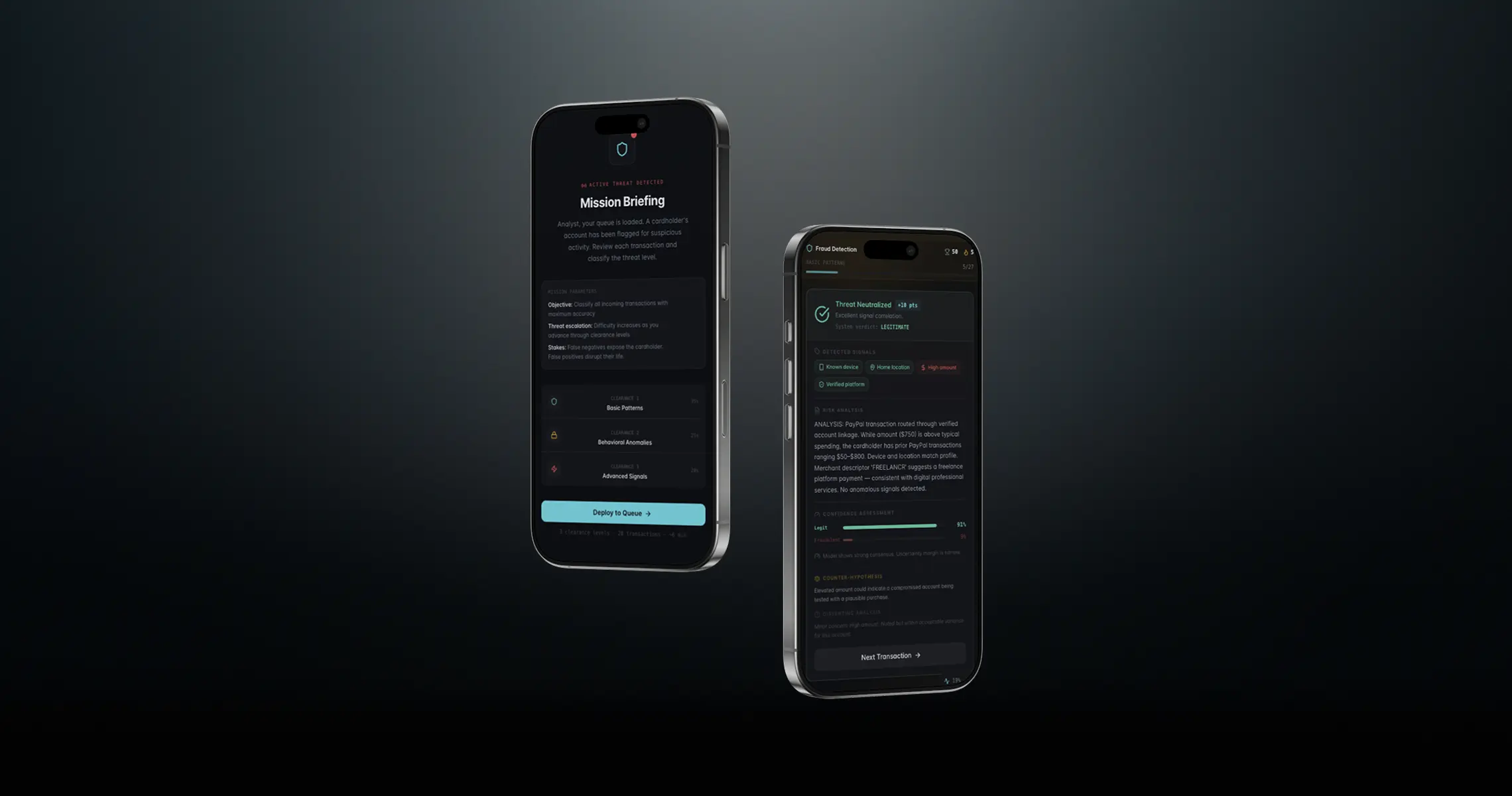
🧪 Experiment No. 01
A gamified fraud detection simulator exploring how AI can guide user decisions in fintech — combining decision-making under uncertainty, pattern recognition, and progressive learning.
Problem
Fraud detection systems are invisible and complex. Users don't understand why transactions are flagged — creating low trust, poor awareness, and reactive behavior.
Hypothesis
If fraud detection becomes interactive, explainable, and slightly gamified, users can better understand risk patterns and make more informed decisions.
The Problem
Most fraud detection happens behind the scenes. When a transaction gets flagged, users receive a binary alert — blocked or approved — with no explanation. They don't understand what triggered the flag, what patterns look suspicious, or how to protect themselves proactively.
This creates a compounding problem: low trust in financial systems, poor user awareness of actual risk signals, and behavior that stays reactive rather than informed.
"What if the fraud detection interface was designed for the user, not just the system?"
The Solution
I designed a gamified fraud detection simulator where users step into the role of a fraud analyst. Instead of passive alerts, they actively review transactions, classify threats, and receive AI-style explanations for each decision.
The experience progressively escalates in complexity — from basic pattern recognition to multi-signal investigation — mirroring how real fraud analysts develop their instincts over time.
Key Features
Users evaluate each transaction across multiple dimensions — amount, location, device fingerprint, and behavioral signals. Each case is unique, avoiding repetition.
Transactions surface contextual signals: unusual location, new device, high amount, abnormal timing. These guide decision-making without giving away the answer.
The system provides proactive hints, post-decision explanations, confidence levels, and pattern recognition feedback — simulating how a real AI co-pilot would behave.
Fraud is presented as linked events — a suspicious login followed by a test transaction followed by an attempt. Users experience fraud as a chain, not isolated incidents.
Score, streak, levels, and badges create engagement without undermining seriousness. The gamification is subtle — it rewards understanding, not just speed.
The experience evolves from simple binary decisions to complex multi-signal investigation, mirroring real skill development.
Demo
Onboarding flow — how the user enters the experience and receives their objective.
Core loop — evaluating a transaction, reading risk signals, and making a decision.
Post-decision AI explanation, confidence breakdown, and score update.
Iteration Process
Each version surfaced a different failure mode in the design thinking.
Basic transaction approve/reject flow. Too linear and repetitive — users ran out of engagement before they ran out of transactions.
Introduced score, streak, and case variation. Improved engagement but the experience still felt like a quiz rather than a simulation.
Added progressive difficulty and dynamic event generation. Users felt progression — but decisions still felt isolated from each other.
Added AI hints, memory across scenarios, connected fraud chains, and uncertainty states. The experience now felt close to a real fraud detection system.
Key Insights
Good interface design does not create engagement without variation and progression. The structure of the experience matters as much as how it looks.
Users engaged significantly more when the system felt proactive, contextual, and aware of past behavior. The AI layer didn't need to be actually intelligent — it needed to feel that way.
Moving from isolated decisions to connected scenarios was the single biggest improvement. Every decision felt more meaningful and realistic.
Too much = trivial. Too little = work. In fintech especially, the balance is critical — the subject matter demands respect even in a simulation.
Potential Impact
This was a design experiment, not a production product. But the concepts have direct application in real fintech contexts:
Banks could embed a lightweight version inside their app — turning fraud alerts into learning moments rather than dead ends.
Users who understand fraud signals are less likely to call support after a block. Education at the point of friction reduces load downstream.
Transparency about why decisions are made builds significantly more trust than opaque automated systems.
A more sophisticated version could onboard junior fraud analysts faster than traditional documentation-heavy training.
Next Steps
Approach & Tools
This experiment was built using a prompt-driven workflow — rapid prototyping with Lovable, iterated through UX design thinking, and evaluated against product criteria at each version.